Car Aircon Compressor Not Working: A Step-by-Step Diagnostic Guide

In Singapore’s tropical climate, a functioning air conditioning system is not a luxury; it is a necessity for driver safety and comfort. When your vents start blowing warm air while you are stuck in traffic on the ECP, the most common culprit is the aircon compressor.

The compressor is the pump that circulates refrigerant through the system. If it fails to engage, the refrigeration cycle stops, and no cooling occurs. Because a compressor replacement is one of the most expensive repairs in an automotive AC system, it is vital to perform a systematic diagnostic to ensure the compressor itself is faulty before committing to a replacement.

This guide provides a technical, step-by-step approach to identifying why a compressor has stopped working, moving from the simplest electrical checks to complex mechanical failures.

Phase 1: Visual and Auditory Initial Checks

Before using any specialized tools, you can gather a significant amount of information just by observing the engine bay while the car is running.

Step 1: The Compressor Clutch Observation

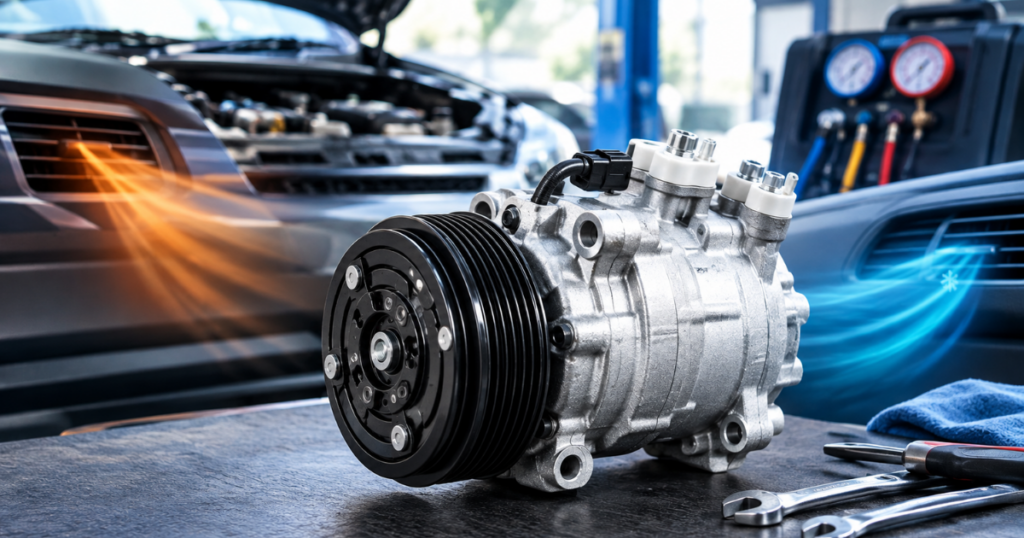
The compressor is driven by the engine’s serpentine belt. On the front of the compressor is a clutch assembly.

  1. Start the engine and turn the aircon to the “Max Cool” setting with the fan on high.
  2. Open the hood and locate the AC compressor.
  3. Observe the front of the pulley. The outer pulley will always be spinning with the belt. However, the inner part (the clutch hub) should also be spinning when the AC is turned on.
    • If the center is spinning: The compressor is receiving power and is mechanically engaged. Your cooling issue is likely a refrigerant leak, a blocked expansion valve, or a clogged cabin filter.
    • If the center is stationary: The compressor is not engaging. This could be due to an electrical fault, a blown fuse, or a safety lockout caused by low refrigerant levels.

Step 2: Listen for Unusual Noises

While observing the compressor, listen for specific sounds:

  • Rapid Clicking: This often indicates the clutch is trying to engage but cannot stay locked, usually due to low voltage or an incorrect air gap in the clutch.
  • Grinding or Squealing: This typically points to a failing compressor bearing or a slipping drive belt.

Phase 3: Electrical System Diagnostics

If the compressor clutch is not spinning, the next step is to determine if the compressor is receiving the “command” to turn on.

Step 1: Check the Fuses

Locate the fuse box (usually in the engine compartment or under the dashboard). Refer to your owner’s manual to find the fuse labeled “AC,” “ACC,” or “COMP.”

  1. Remove the fuse and inspect the wire filament inside.
  2. If the wire is broken, replace it with a fuse of the exact same amperage.
  3. Note: If the new fuse blows immediately, there is a short circuit in the compressor clutch coil or the wiring that must be repaired.

Step 2: Inspect the AC Compressor Relay

The relay is the switch that sends high-current power to the compressor.

  1. Locate the AC relay in the engine fuse box.
  2. A quick way to test it is to find another relay in the box with the exact same part number (such as the horn relay) and swap them.
  3. If the aircon starts working with the swapped relay, you simply need to purchase a new relay.

Step 3: Test for Power at the Compressor

If the fuses and relays are intact, you must check if electricity is actually reaching the compressor.

  1. Unplug the single-wire or two-wire connector at the compressor.
  2. Using a multimeter or a 12V test light, check the connector terminal while the AC is turned on inside the car.
    • If there is 12V power: The car’s computer is sending the signal, but the compressor’s electromagnetic clutch is burnt out and needs replacement.
    • If there is no power: The car’s computer is intentionally blocking the compressor from turning on, likely due to a safety sensor.

Phase 4: Pressure Sensor and Refrigerant Checks

Modern automotive AC systems are equipped with high-pressure and low-pressure switches. If the system detects that the refrigerant level is too low (which could cause the compressor to overheat) or too high (which could blow a hose), it will cut power to the compressor to prevent catastrophic damage.

Step 1: Static Pressure Test

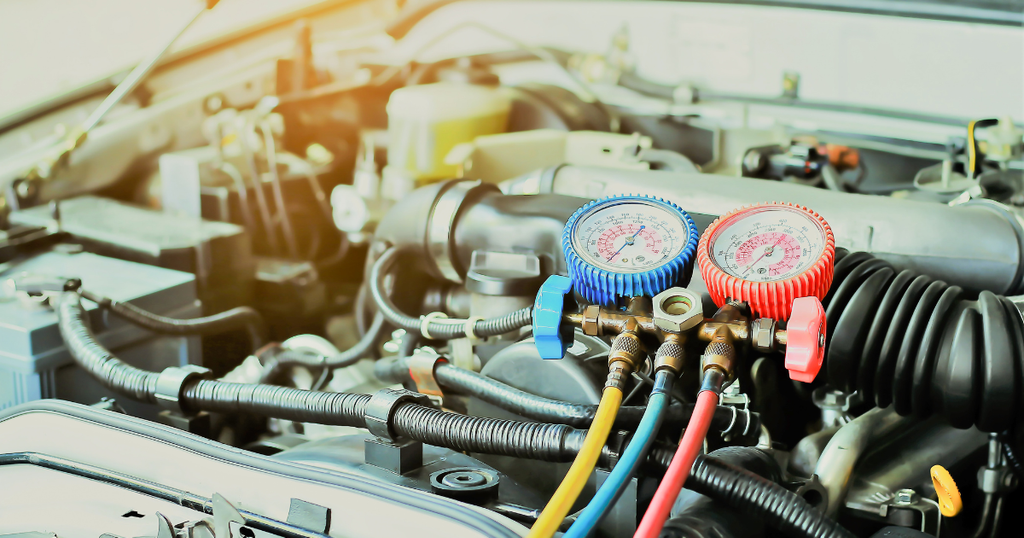
To check if there is enough gas to trigger the compressor, you will need a set of AC manifold gauges.

  1. With the engine off, connect the gauges to the high and low-side service ports.
  2. Check the static pressure. Depending on the ambient temperature in Singapore (approx. 30°C–33°C), you should see a static pressure of roughly 80–90 PSI.
  3. If the pressure is zero or very low: You have a significant leak. The low-pressure switch has cut power to the compressor to protect it from running dry without lubrication. You must find the leak and recharge the system before the compressor will engage again.

Step 2: Testing the Pressure Switch

If you have sufficient pressure but no power to the compressor, the pressure switch itself might be faulty.

  1. Locate the pressure sensor on the AC lines.
  2. A technician will typically use a scan tool to see what pressure the sensor is reporting to the engine control unit (ECU). If the sensor reports 0 PSI despite the gauges showing 90 PSI, the sensor is faulty and needs replacement.

Does your aircon only blow cold air when the car is moving? Contact Us today for a professional AC system pressure test and diagnostic.

Don’t let the Singapore heat ruin your commute. Book your aircon inspection at MotoServ now to ensure your cooling system is efficient and reliable.

Phase 5: Internal Mechanical Failures (The “Black Death”)

If your electrical checks pass and your refrigerant levels are correct, but the compressor still fails to circulate gas, you are likely dealing with an internal mechanical failure. In the automotive industry, the worst-case scenario is known as “Black Death.”

This occurs when the internal pistons or swash plate of the compressor begin to disintegrate. As the metal grinds away, it creates a fine, metallic “sludge” that turns the clear refrigerant oil into a black, abrasive paste. This sludge doesn’t stay in the compressor; it is pumped throughout the entire system, clogging the condenser, the expansion valve, and the evaporator.

Diagnostic Sign: If a technician removes your AC lines and finds black, oily debris inside the hose connectors, the compressor has “grenaded.” In this situation, simply replacing the compressor is useless; the new unit will be destroyed by the leftover debris within days. You must perform a full system flush or replace the condenser and expansion valve as well.


Phase 6: Step-by-Step Compressor Replacement

Replacing a compressor is a “closed-loop” repair. You cannot simply unbolt it; the system must be professionally handled to avoid legal and environmental penalties.

Step 1: Refrigerant Recovery

In Singapore, it is illegal to vent refrigerant (R134a or R1234yf) into the atmosphere. You must use a recovery machine to extract the gas.

  • Action: Connect the recovery station to the service ports and wait until the system is at “zero” pressure. This also recovers a small amount of oil, which must be measured so the same amount can be added back later.

Step 2: Disconnect the Battery and Belt

For safety, disconnect the negative battery terminal. Locate the serpentine belt tensioner. Use a long-handle wrench to rotate the tensioner and slide the belt off the compressor pulley. Inspect the belt for cracks; if it’s worn, this is the best time to replace it.

Step 3: Remove the Refrigerant Lines

Unbolt the high-pressure and low-pressure lines from the compressor.

  • Pro Tip: Immediately “cap” or plug the open lines with rubber stoppers. This prevents moisture from Singapore’s high-humidity air from entering the system and contaminating the desiccant.

Step 4: Unbolt and Remove the Unit

Most compressors are held by three or four long bolts. Once unbolted, carefully lift the compressor out of the engine bay. Note that it is heavy and may contain residual oil—keep it upright to avoid spills.

Step 5: Prep the New Compressor

New compressors often come “pre-filled” with a shipping oil. You must drain this oil and add the specific amount of PAG oil required by your vehicle’s manufacturer. Too much oil reduces cooling efficiency; too little causes the new compressor to seize.

Step 6: Installation

Mount the new compressor and torque the bolts to the factory specification (usually 20–30 Nm). Reattach the lines using new O-rings lubricated with AC oil. Reinstall the serpentine belt and ensure it is seated correctly in all the pulley grooves.


Phase 7: The “Supporting Cast” (Drier & Expansion Valve)

When a compressor fails, it is standard industry practice to replace two other parts. If you skip these, your warranty is usually voided.

  1. The Receiver Drier (or Accumulator): This acts as the “filter” for the AC system. It contains desiccant beads that soak up moisture. Once the system is opened for a compressor swap, the drier is exposed to air and becomes “saturated.” A fresh drier is essential for a long-lasting repair.
  2. The Expansion Valve (TX Valve): This is the “nozzle” that turns liquid refrigerant into a cold mist. Because the opening is tiny, it is the first place that debris from a failing compressor will settle. If it’s partially clogged, your new compressor will work too hard and fail prematurely.

Phase 8: Vacuuming and Recharging

Once the hardware is installed, the system is full of air and moisture, which must be removed before adding refrigerant.

Step 1: Pulling a Vacuum

Connect a vacuum pump to the system. Run the pump for at least 30 to 45 minutes. This lowers the pressure so much that any moisture inside the pipes “boils” off and is sucked out.

  • Leak Test: Once the vacuum is pulled, turn off the pump and watch the gauges for 15 minutes. If the needle moves back toward zero, you have a leak in your new connections that must be fixed before proceeding.

Step 2: Recharging by Weight

Every car has a specific refrigerant capacity (e.g., 450g or 550g) listed on a sticker under the hood.

  • Action: Use a digital scale to charge the system with the exact weight of refrigerant. Do not “guess” based on pressure alone, as modern systems are highly sensitive to overcharging.

Conclusion: Restoring the Chill

A compressor replacement is a major repair that requires precision. From ensuring the electrical command is reaching the clutch to performing a deep vacuum to remove Singapore’s humidity, every step is vital for a system that can withstand 33°C traffic jams.

By following a systematic diagnostic and replacing the supporting components like the drier and expansion valve, you ensure that your aircon doesn’t just work for a week, but remains ice-cold for years to come.

Recent Post

Latest Promotion

Scroll to Top