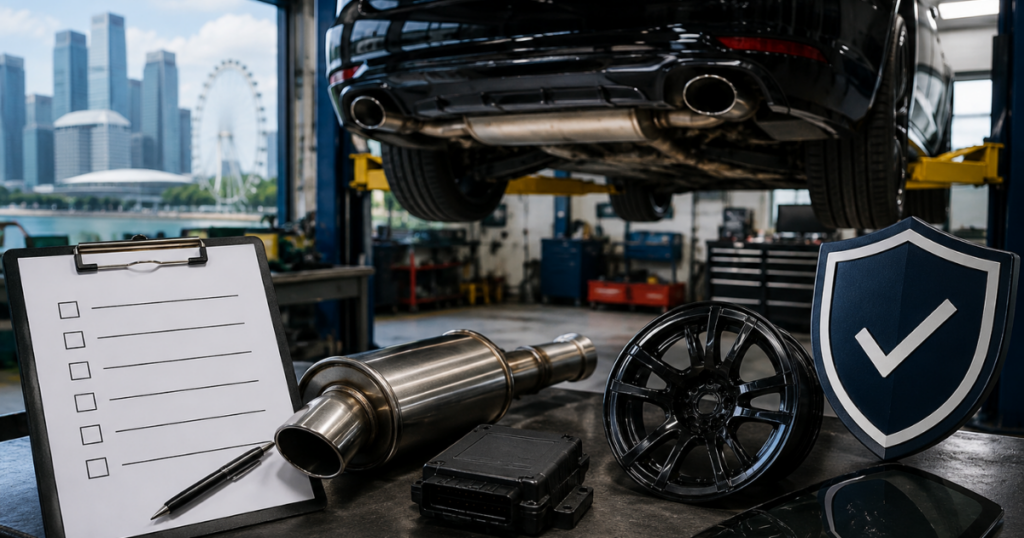
2026 Illegal Car Modification & Servicing
In 2026, Singapore’s approach to illegal vehicle modifications has become a greater concern for both car owners and workshops, particularly when a modified vehicle is brought in for servicing, inspection, or repairs. The updated requirements place greater emphasis on ensuring that vehicle modifications remain compliant and that workshops do not knowingly permit or carry out work involving non-compliant modifications. For car owners, this means that aftermarket parts should not simply be judged by whether they improve performance or appearance—they should also be checked for compliance before servicing or further modification. Understanding these changes can help you avoid unexpected inspection issues, unnecessary rectification work, and potential penalties, while choosing a professional workshop that can assess your vehicle and advise you on the appropriate next steps.
What Are the Penalties for Illegal Modifications?
For car owners and drivers, illegal vehicle modifications can lead to serious financial and legal consequences, so it is important to check that aftermarket parts are properly approved before they are installed or retained on the vehicle. Based on the existing article, first-time individual offenders may face fines of up to $20,000 and/or up to 2 years’ imprisonment, while repeat offenders may face fines of up to $40,000 and/or up to 4 years’ imprisonment. Workshops also carry significant responsibility: the existing article states that companies may face fines of up to $40,000 for a first offence and $80,000 for a repeat offence, particularly where they are found to have permitted an illegal modification. For owners, the key takeaway is simple: an aftermarket modification should not be treated as acceptable simply because it is already fitted to the vehicle—its compliance should be confirmed before servicing, further modification, or inspection.

How Can Illegal Modifications Affect Your Car Servicing?
When you bring your car to a workshop for servicing, an unapproved modification may become an issue if it affects the vehicle’s compliance or the work being carried out. A professional workshop may need to inspect the relevant component, explain the compliance concern, and advise you on what needs to be corrected before proceeding. In some situations, the workshop may refuse to carry out work connected to a non-compliant modification because continuing could place the workshop at risk of being seen as permitting or facilitating the issue. This does not mean that every aftermarket part is illegal; the important point is whether the modification meets the applicable requirements.
For car owners, the safest approach is to be open with the workshop about any aftermarket parts already fitted to the vehicle and check their compliance before further servicing or modification. If a workshop identifies a potential problem, ask for a clear explanation of what needs to be checked or rectified rather than continuing with the modification. Keeping relevant approval, inspection and servicing records can also make future maintenance easier. Taking these steps helps you maintain your vehicle responsibly and reduces the chance of unexpected compliance problems when your car needs servicing or inspection. For professional assistance with your vehicle’s maintenance and servicing needs, you can also explore our [Car Service].
Which Parts Should You Check Before Servicing?
Before taking your car for servicing, check the main aftermarket or modified areas that could affect its compliance. The most important areas to review are the exhaust and emissions system, OBU/ERP 2.0, and window tint. Checking these beforehand can help you identify potential issues early, discuss them with your workshop, and avoid unnecessary problems during servicing or inspection. You can also review the relevant LTA guidance for applicable requirements and consider services such as CataClean where appropriate to your vehicle’s maintenance needs.
| Area to Check | What the Owner Should Check |
| Exhaust & Emissions | Check whether an aftermarket exhaust or related modification has the required approval and remains in an acceptable condition. |
| OBU / ERP 2.0 | Make sure the OBU has not been removed, repositioned or interfered with, and avoid modifications that could affect its operation. |
| Window Tint | Check that the front and rear windows meet the applicable light-transmission requirements and that the front windscreen does not interfere with OBU/ERP signal transmission. |
What If Your Car Is Flagged?
If your car is flagged for an illegal modification, the first step is to identify the issue and have the non-compliant component removed, replaced, or properly rectified. Once the necessary work has been completed, the vehicle may need to undergo another inspection to confirm that the issue has been resolved.
Depending on the modification and the circumstances, further inspection may be required before the vehicle is considered compliant. It is also advisable to keep records of the rectification work carried out, particularly where documentation may be needed during a subsequent inspection.
If the vehicle is placed under the Enhanced Inspection Regime (EIR), inspections become more frequent. A second offence requires inspection every 6 months for 2 years, while a third or subsequent offence requires inspection every 3 months for 2 years, so the vehicle must remain compliant throughout the EIR period.
What Should You Do If Your Car Already Has a Modification?
If your car already has a modification, do not assume that it is automatically legal or compliant. The safest approach is to identify what has been changed, confirm whether it has the required approval, and keep any supporting documents. If you are unsure, have the vehicle professionally assessed through a Pre-Purchase Inspection or Car Service and rectify any issue before continuing with further modifications or servicing.
| Step | What You Should Do |
| Identify the modification | Determine exactly what has been changed on the vehicle, such as the exhaust, wheels, suspension, lighting, window tint, or other components. |
| Check whether it is approved | Confirm that the modification meets the applicable requirements and has the necessary approval or certification where required. |
| Keep relevant documents | Keep approval certificates, receipts, inspection records, or other documents related to the modification in case they are needed later. |
| Tell the workshop | Always inform the workshop about existing modifications before servicing or inspecting the vehicle. This allows the technicians to take them into account during their assessment. |
| Have the vehicle professionally assessed | If you are uncertain about the modification, arrange a professional assessment to determine whether it complies with the applicable requirements. |
| Rectify the issue if required | If the assessment identifies a non-compliant modification, have it properly rectified or returned to a compliant condition before proceeding. |

How Can a Professional Workshop Help?
A professional workshop can help identify potential issues with existing modifications during a routine Car Service or inspection. Experienced technicians can assess the vehicle, check components that may require attention, and identify problems that may not be obvious to the owner.
Proper diagnosis is important before any corrective work is carried out. Depending on the vehicle and the issue identified, services such as Gan Tuning or CataClean may be relevant, while the workshop can recommend appropriate maintenance or rectification based on the vehicle’s condition.
| How a Workshop Can Help | What It Involves |
| Identify Potential Issues | Inspect relevant vehicle components and identify modifications or mechanical issues that may require further attention. |
| Diagnosis & Maintenance | Use appropriate inspection and diagnostic procedures to determine the condition of the vehicle and recommend necessary maintenance. |
| Rectification Support | Where an issue is identified, carry out suitable rectification work to help return the vehicle to an appropriate and compliant condition. |
Quick 2026 Checklist
Use this quick checklist before servicing, inspecting, or making further changes to your vehicle:
| Checklist | What to Check |
| Modification approved | Confirm that any aftermarket modification has the required approval or certification where applicable. |
| Exhaust compliant | Check that the exhaust system meets the applicable requirements and has the necessary approval where required. |
| Window tint compliant | Make sure the front windscreen and front side windows meet the required light-transmission requirements. |
| OBU functioning correctly | Check that the vehicle’s On-Board Unit is functioning properly and has not been altered or interfered with. |
| Inspection requirements checked | Confirm whether your vehicle has any current inspection requirements, including additional inspections that may apply. |
| Service/inspection records kept | Keep relevant servicing, inspection, approval, and rectification records for future reference. |
| Workshop informed about aftermarket parts | Tell the workshop about existing aftermarket components before servicing or inspection so they can be considered during the assessment. |
Final Thoughts
If you are unsure about an existing modification, it is better to have it checked before your next service or inspection rather than wait for a compliance issue to arise. A professional workshop can assess the vehicle, explain any concerns, and advise you on the appropriate maintenance or rectification needed based on its condition. If you need assistance with your vehicle, you can contact our workshop for professional advice and servicing support.