
If your car’s dashboard sometimes feels like it’s speaking a different language with its constant beeps, alerts, and mysterious acronyms like AEB or LKA, you are not alone. Many drivers in Singapore feel unsure about the complex technology in their vehicles, wondering if they can fully trust it and what potential repair costs might be. These features are all part of your car’s advanced driver-assistance systems (ADAS), a sophisticated network of sensors and cameras designed to be your second pair of eyes on the road.
This guide is here to provide clarity and peace of mind. We will demystify common ADAS features like adaptive cruise control and automatic emergency braking, helping you feel more confident and safe behind the wheel. You will also learn why proper calibration and professional maintenance are crucial for keeping this safety technology reliable, ensuring it protects you and your family on every journey across Singapore.
What is ADAS? Your Car’s Invisible Co-Pilot Explained
Think of Advanced Driver-Assistance Systems (ADAS) as an intelligent, invisible co-pilot, always alert and ready to help. In simple terms, ADAS is a suite of safety features designed to assist you while driving, making your journey on Singapore’s roads safer and less stressful. These technologies act as an extra set of eyes and ears, using a network of sensors and cameras to monitor your vehicle’s surroundings and warn you of potential dangers you might not see.
The primary goal of these systems is to increase safety by reducing human error, which is the leading cause of traffic accidents. While they enhance vehicle safety and automation, it is crucial to understand that an advanced driver-assistance system (Wikipedia) is not the same as a fully autonomous or self-driving car. With ADAS, you are always the driver and must remain in full control of the vehicle; the system is there to support you, not replace you.
The Main Purpose: Safety and Convenience
At its core, ADAS is engineered to provide peace of mind. By constantly scanning the road, these systems can react faster than a human, helping to prevent collisions or reduce their severity. For Singapore drivers, this means greater confidence in heavy traffic and on long drives. Features like Adaptive Cruise Control also reduce driver fatigue, making your daily commute more comfortable and convenient.
This focus on technology for peace of mind extends beyond driving assistance to include advanced security measures. In the UK, for instance, specialists like Safe & Sound Mobile are known for fitting vehicles with security and tracking systems that complement the built-in safety features of modern cars.
Key Components That Make ADAS Work
The magic behind ADAS relies on three key types of technology working together seamlessly:
- Sensors (Radar, Lidar, Ultrasonic): These are the car’s “senses.” They constantly emit waves to detect the position, speed, and distance of other vehicles and objects around you, even in poor weather conditions.
- Cameras: Acting as the car’s “eyes,” cameras are mounted around the vehicle to read lane markings, recognise traffic signs, and identify pedestrians or cyclists.
- The Central Processor: This is the “brain” of the system. It takes all the information from the sensors and cameras, analyses it in milliseconds, and activates a warning or assistance feature when necessary.
Common ADAS Features in Modern Cars: A Plain English Guide
Modern cars are equipped with a suite of safety technologies designed to make driving safer and less stressful. Instead of being one single system, these advanced driver-assistance systems are a collection of individual features, each solving a specific problem. To make them easier to understand, we can group them by their main function, a method also used in the comprehensive National Safety Council guide to ADAS. Here are the common features you’ll find in cars on Singapore’s roads, explained in plain English.
Features That Help You Drive and Maintain Distance
These systems are designed to reduce driver fatigue and help you manage the flow of traffic with greater ease and safety.
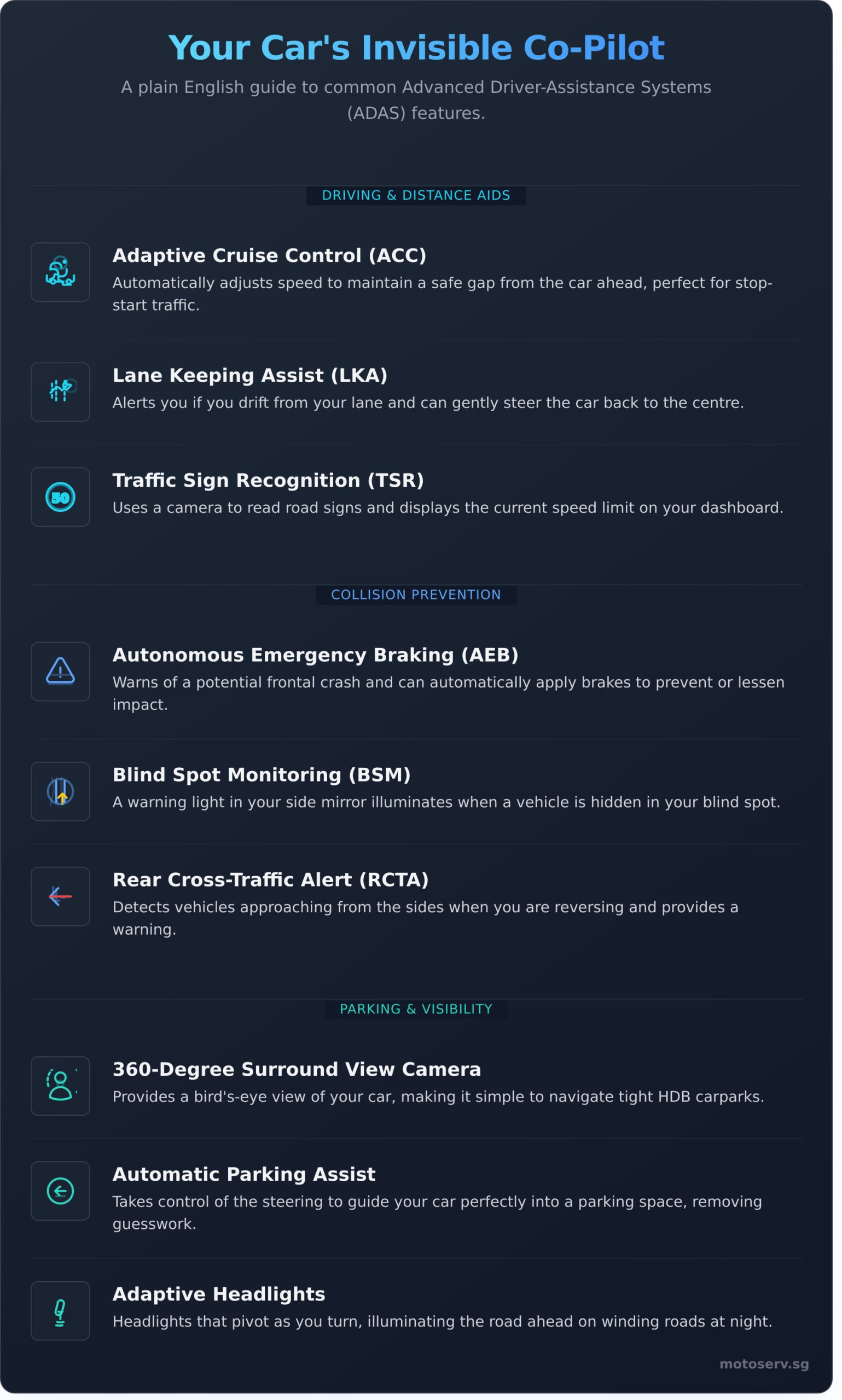
- Adaptive Cruise Control (ACC): More than just for highways, ACC is a lifesaver in Singapore’s stop-start traffic. It automatically adjusts your car’s speed to maintain a safe gap from the vehicle in front, even on the PIE or CTE during peak hours.
- Lane Keeping Assist (LKA) & Lane Departure Warning (LDW): If you get momentarily distracted and drift from your lane, LDW alerts you. LKA provides an extra layer of safety by gently steering the car back into the centre of the lane.
- Traffic Sign Recognition (TSR): It’s easy to miss a temporary speed limit sign near roadworks. This system uses a camera to read road signs and displays the current speed limit on your dashboard, helping you avoid accidental fines.
Features That Actively Prevent Collisions
Think of these features as a vigilant co-pilot, always scanning for potential hazards and ready to intervene to protect you.
- Autonomous Emergency Braking (AEB) & Forward Collision Warning (FCW): FCW alerts you to a potential frontal crash. If you don’t react, AEB can automatically apply the brakes to prevent or lessen the impact—a crucial feature when a car brakes suddenly ahead of you.
- Blind Spot Monitoring (BSM): This system solves the dangerous problem of vehicles hidden in your blind spot. A warning light in your side mirror illuminates when a car or motorcycle is present, preventing an unsafe lane change.
- Rear Cross-Traffic Alert (RCTA): Reversing out of a parking spot at a busy shopping centre can be nerve-wracking. RCTA detects vehicles approaching from the sides and warns you, making it much safer to back out.
Features That Improve Parking and Visibility
These aids take the stress out of navigating tight spaces and driving in low-light conditions.
- 360-Degree Surround View Camera: By stitching together images from several cameras, this system provides a bird’s-eye view of your car. It makes navigating narrow HDB carpark ramps and fitting into tight lots simple, protecting your rims and paintwork.
- Automatic Parking Assist: For many, parallel parking is a challenge. This feature takes control of the steering to guide your car perfectly into a space, removing the guesswork and anxiety.
- Adaptive Headlights: When driving on winding roads at night, these headlights pivot as you turn, illuminating the road ahead rather than the roadside.
How ADAS Sensors ‘See’ the World Around Your Vehicle
The technology behind advanced driver-assistance systems may seem complex, but it operates on a simple principle: a team of specialised sensors working together to build a complete and reliable picture of your surroundings. It’s not magic; it’s a robust combination of different technologies, each with a specific job. Think of it as giving your car multiple sets of eyes and ears, each designed for a different situation. This multi-sensor approach, as explained by safety experts like the National Safety Council, is what makes modern Advanced Driver Assistance Systems so dependable.
To ensure your safety, these systems rely on three main types of sensors:
Cameras: The Eyes of the System
Just like your own eyes, cameras are excellent at interpreting visual information. Usually mounted behind the windscreen near the rearview mirror, they are responsible for reading lane markings for Lane Keep Assist, identifying traffic signs, and detecting pedestrians. However, much like human vision, their performance can be limited in heavy rain, dense fog, or low-light conditions, which is why they are part of a larger team.
Radar: Judging Speed and Distance
Radar sensors work by sending out radio waves that bounce off objects. By measuring the return signal, the system can accurately determine the distance, speed, and direction of other vehicles. This makes radar the perfect tool for features like Adaptive Cruise Control (ACC) and Autonomous Emergency Braking (AEB). A key advantage is its excellent performance in poor weather, providing reliable data even when cameras struggle in Singapore’s heavy downpours.
Ultrasonic and Lidar Sensors: Close-Range Experts
For navigating tight spots, your car relies on close-range experts. Ultrasonic sensors, typically found in the bumpers, use sound waves to detect objects very close to the vehicle, making them essential for parking assistance and blind-spot monitoring. Some newer, more advanced systems also use Lidar (Light Detection and Ranging), which creates a precise 3D map of the environment. Together, these sensors give your car impeccable awareness during low-speed manoeuvres, ensuring you avoid costly bumps and scrapes.
Why Your ADAS Needs Professional Maintenance and Calibration
Your car’s advanced driver-assistance systems are not just convenient electronic features; they are a network of high-precision sensors and cameras working together to keep you safe. For these systems to function correctly, their alignment must be perfect. Even a minuscule deviation of one degree can cause a sensor to misjudge distances by several metres down the road, compromising its life-saving potential. Proper maintenance and calibration are therefore not optional—they are critical for your safety on Singapore’s roads.
What is ADAS Calibration?
ADAS calibration is the professional process of realigning your vehicle’s cameras and sensors to precise manufacturer specifications. Think of it like adjusting the focus on a professional camera. If the lens is not perfectly focused, the image it captures will be blurry and unreliable. Similarly, calibration ensures your ADAS ‘sees’ the world correctly, accurately interpreting lane markings, other vehicles, pedestrians, and road signs.
Common Reasons Your Car Needs ADAS Calibration
The delicate alignment of your ADAS sensors can be disrupted by several common events. It is essential to seek professional calibration if your vehicle has undergone:
- Windscreen Replacement: This is the most frequent reason. The forward-facing camera is typically mounted on the windscreen, and a replacement requires immediate recalibration to ensure its view is accurate.
- Collision Repair: Even a minor bump in a car park can knock radar sensors in your bumper or grille out of alignment, affecting features like blind-spot monitoring or adaptive cruise control.
- Wheel Alignment or Suspension Changes: Any work that alters your car’s ride height or angle relative to the road will change the perspective of the ADAS cameras, making recalibration necessary.
- Dashboard Warning Light: If an ADAS-related warning light illuminates on your dashboard, it is a clear signal that the system has detected a fault and requires expert diagnosis.
The Risks of Ignoring Calibration
Driving with an uncalibrated ADAS is a significant safety risk. A misaligned system can lead to dangerous situations, such as the Automatic Emergency Braking (AEB) failing to engage in time or activating unexpectedly on the expressway. Features like Lane Keep Assist (LKA) could either fail to detect lane markings or, worse, steer the car incorrectly. These malfunctions not only fail to prevent an accident but can actively cause one. To ensure your vehicle’s safety systems perform reliably, trust our certified technicians with your ADAS calibration.
Choosing a Workshop for ADAS Service in Singapore
When your vehicle’s windscreen is replaced or it has been in a minor accident, the sensors and cameras that power your advanced driver-assistance systems may need recalibration. This is not a standard repair job. These intricate systems require specialised knowledge and equipment, and not every workshop in Singapore is prepared to handle them correctly. Choosing the right service provider is crucial to ensure your safety features function as intended.
Making an informed decision protects your safety and your investment. Here’s what to look for when selecting a workshop for ADAS calibration and servicing.
What to Look For in an ADAS Workshop
To ensure your vehicle is in capable hands, verify that the workshop meets these essential criteria:
- Technician Training and Certification: Ask if the technicians are certified to work on ADAS. Credentials from respected bodies like the Institute of the Motor Industry (IMI) indicate a high level of training and expertise.
- Proper Equipment and Software: A qualified workshop must have manufacturer-approved calibration tools, targets, and the latest diagnostic software. Generic tools cannot guarantee the precision required for these safety systems.
- Experience with Your Car Make: Whether you drive a Japanese or Continental car, the workshop should have proven experience with the specific ADAS technology used in your vehicle’s make and model.
- Transparent Process: A reliable workshop will clearly explain the calibration process, provide a detailed report of the work done, and be transparent about all costs involved.
Why Trust Motoserv with Your Vehicle’s Safety Systems?
At Motoserv, we understand that your vehicle’s safety systems are non-negotiable. We have invested heavily in the technology and training required to provide professional, reliable ADAS servicing you can count on. When you entrust your car to us, you benefit from:
- IMI Certified Technicians: Our team is highly trained and certified, ensuring every calibration is performed to the highest industry standards for your peace of mind.
- State-of-the-Art Equipment: We use the latest diagnostic and calibration equipment to service your advanced driver-assistance systems with absolute precision.
- Comprehensive Expertise: We have extensive experience servicing a wide range of Japanese and Continental vehicles, making us a one-stop solution for drivers across Singapore.
- CASETRUST Accreditation: Our commitment to quality service and fair practices is backed by our CASETRUST accreditation, giving you an extra layer of confidence.
Don’t compromise on safety. For expert ADAS servicing and calibration, contact a Motoserv workshop near you today.
Entrust Your ADAS to the Experts for Ultimate Peace of Mind
As we’ve explored, the advanced driver-assistance systems in your vehicle are a complex network of sensors and software designed to protect you on Singapore’s roads. These features are your invisible co-pilot, but they require precise, professional maintenance to function reliably. Even a minor misalignment after a bump or windscreen replacement can compromise their effectiveness, putting your safety at risk.
When servicing such critical safety technology, you need a workshop you can trust. At Motoserv, we provide that assurance. As a CASETRUST Accredited workshop, our IMI (UK) Certified Technicians use specialised ADAS calibration equipment to ensure every component functions exactly as the manufacturer intended. We offer the expertise and quality you can count on for your peace of mind.
Ensure your vehicle’s safety systems are performing at their best. Book an appointment with our ADAS experts today and drive with the confidence that your car’s safety features are in expert hands.
Frequently Asked Questions About ADAS
Do all new cars in Singapore come with ADAS?
While increasingly common, not all new cars sold in Singapore are equipped with ADAS as standard. These safety features are more prevalent in mid-to-high-tier models from most manufacturers. When purchasing a new vehicle, it is essential to check the specific trim level and specification sheet or confirm with the authorised dealer to see which ADAS features are included. Always verify the exact safety package before making a decision.
Can I turn off the ADAS features in my car?
Yes, most vehicles allow drivers to temporarily disable certain ADAS functions, such as Lane Departure Warning or Adaptive Cruise Control, via the infotainment system or dashboard controls. However, for your safety, we advise against this. It is also important to note that critical safety systems like Autonomous Emergency Braking (AEB) may automatically reactivate each time you start the car, as designed by the manufacturer to ensure maximum protection.
How do I know if my car’s ADAS needs to be calibrated?
Your vehicle will often display a warning light or error message on the dashboard if a system fault is detected. You should also seek a professional calibration if you’ve had a windscreen replacement, suspension work, a wheel alignment, or even a minor accident. If you notice features like lane-keeping assist behaving erratically, it’s a clear sign that your system requires expert attention from a certified technician to restore its accuracy and reliability.
Does ADAS work effectively in Singapore’s heavy rain and hazy conditions?
The performance of advanced driver-assistance systems can be limited by adverse weather. Heavy rain, thick haze, or dense fog can obstruct the view of the system’s cameras and interfere with its radar and LiDAR sensors. This can reduce their effectiveness or cause them to disengage temporarily. In such conditions, drivers in Singapore should always remain fully alert and not depend solely on ADAS for their safety on the road.
Is ADAS calibration covered by car insurance?
In Singapore, if ADAS calibration is required as part of a repair following an accident, it is typically covered by most comprehensive car insurance policies. For example, if your windscreen is replaced under an insurance claim, the subsequent camera recalibration should be included. However, policies vary, so we recommend you review your specific insurance plan or speak with your provider to confirm the details of your coverage before proceeding with any work.
Will modifying my car, like changing wheels, affect the ADAS?
Yes, absolutely. Modifications can significantly impact the performance of your car’s ADAS. Changing wheel or tyre sizes, altering the suspension height, or even applying a dark tint to your windscreen can misalign the precise angles of the system’s cameras and sensors. This can cause malfunctions and compromise your safety. We strongly recommend a professional ADAS recalibration after any such modifications to ensure all systems function correctly.