Making the switch to an electric vehicle in Singapore is an exciting step towards the future. However, it often comes with a new set of questions and concerns. Are you unsure about what maintenance your EV actually needs? Worried about the high cost of battery repairs or finding a trustworthy workshop with certified technicians? You’re not alone. The world of electric vehicle maintenance is different, and navigating it without clear guidance can feel overwhelming, especially when your vehicle’s warranty is on the line.
This essential guide is designed to provide clarity and give you peace of mind. We will walk you through exactly what your EV needs to stay safe, reliable, and efficient on Singapore’s roads. You’ll receive a straightforward maintenance checklist, understand the key differences from a petrol car, and learn how to choose a professional workshop that protects both your investment and its resale value. Entrust us to make your EV ownership experience smooth and worry-free.
EV vs. Petrol Car Maintenance: What’s Gone and What’s New?
Making the switch to an electric vehicle (EV) brings many benefits, and one of the most significant is a simplified maintenance schedule. The fundamental design of an EV, which uses an electric motor powered by a battery pack, is vastly different from a traditional petrol car. Understanding what is an electric vehicle at its core reveals why so many familiar service items are no longer necessary. This shift dramatically changes the landscape of electric vehicle maintenance, leading to fewer workshop visits and lower long-term running costs for owners in Singapore.
While you can say goodbye to the greasy, complex world of internal combustion engines, a new set of priorities emerges, focusing on the high-voltage systems that power your journey. Let’s explore what has changed.
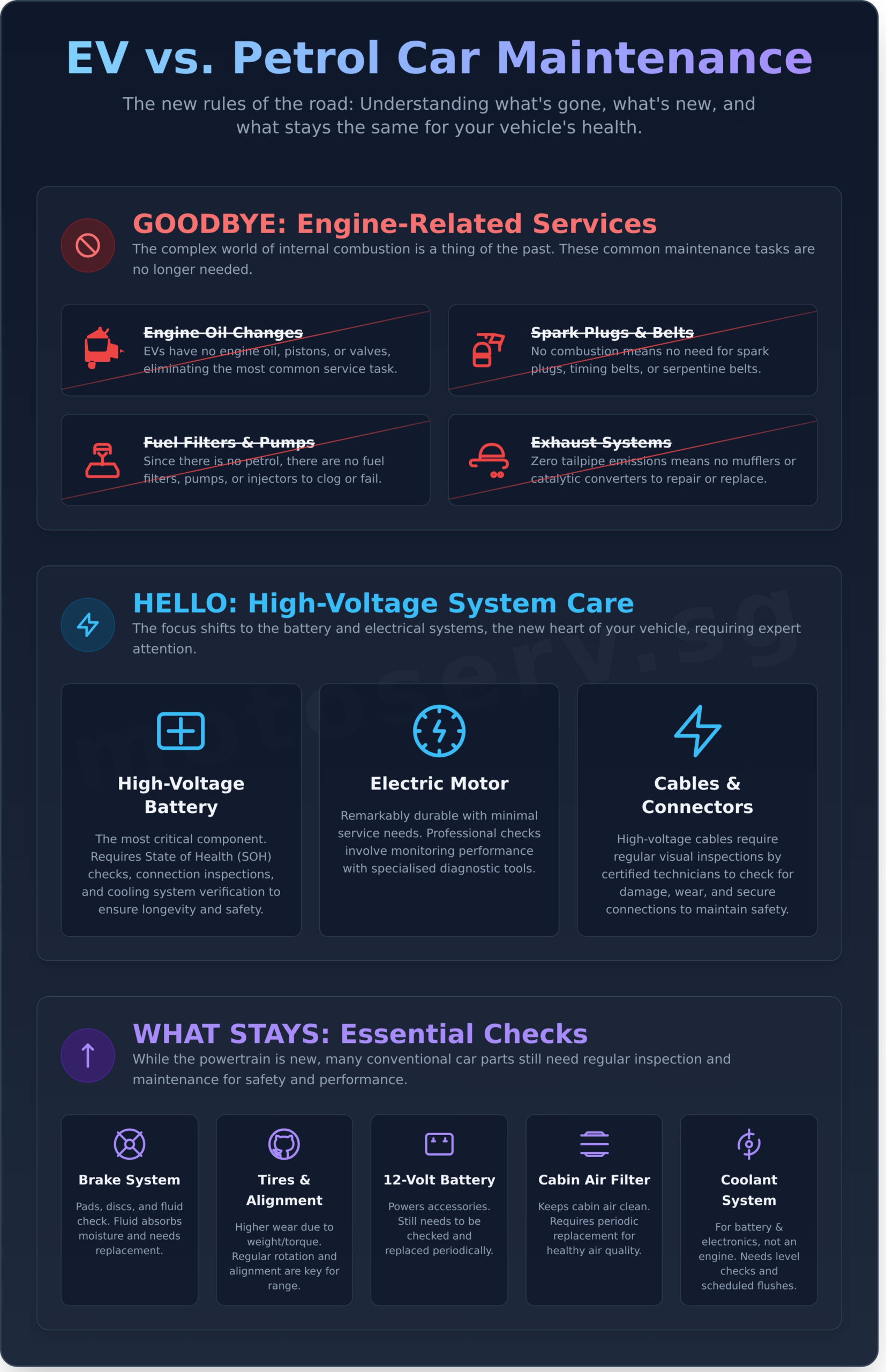
Goodbye to Engine-Related Services
For decades, car ownership has been synonymous with regular engine servicing. With an EV, you can forget about the most common and costly engine-related tasks. The simplified drivetrain has far fewer moving parts, eliminating the need for:
- Engine Oil Changes: EVs have no engine oil, pistons, or valves, making routine oil and filter changes a thing of the past.
- Spark Plugs and Belts: Without combustion, there is no need for spark plugs, timing belts, or serpentine belts.
- Fuel Filters: There is no petrol, so there are no fuel filters, pumps, or injectors to clog or fail.
- Exhaust Systems: As EVs produce zero tailpipe emissions, you will never have to worry about a rusty muffler or a faulty catalytic converter again.
Hello to High-Voltage System Care
The focus of professional electric vehicle maintenance shifts from the engine to the battery and electrical systems. The battery pack is the new ‘heart’ of your vehicle, and while it’s designed for longevity, it requires expert attention. Our certified technicians inspect high-voltage cables and connectors for integrity and safety. The electric motor itself is remarkably durable with minimal service needs, but the entire system requires specialised diagnostic tools to monitor performance and health, ensuring your EV runs efficiently and safely.
Familiar Components That Still Need Love
While the powertrain is different, an EV is still a car with parts that experience wear and tear. Regular checks on these shared components are essential for your safety:
- Brakes, Tires, and Suspension: These systems still require routine inspection and replacement.
- 12-Volt Battery: Your EV still has a small 12V battery to power lights, infotainment, and other accessories. This battery can still go flat and needs to be checked.
- Cabin Air Filter: This filter keeps the air inside your car clean and needs periodic replacement.
- Coolant: EVs have a thermal management system to cool the battery and electronics, and this coolant needs to be serviced as per the manufacturer’s schedule.
The Core EV Maintenance Checklist: Key Systems to Service
While EVs have fewer moving parts than petrol cars, a structured approach to electric vehicle maintenance is crucial for safety and longevity. Key systems require professional attention to ensure they operate at peak efficiency. Understanding the core EV maintenance requirements helps owners appreciate the importance of these checks. Our IMI (UK) certified technicians follow this detailed checklist to give you complete peace of mind.
High-Voltage Battery Health Check
The battery is the heart of your EV. Our expert service includes a State of Health (SOH) check using advanced diagnostic software to assess its capacity and performance. We also perform a thorough visual inspection of the battery casing for any signs of damage or leaks and ensure all high-voltage connections are secure and free from corrosion. Finally, we verify the battery’s dedicated cooling system is functioning correctly to prevent overheating and preserve its lifespan.
Brake System and Fluid Service
Regenerative braking reduces wear on brake pads, but the hydraulic system still demands attention. Brake fluid is hygroscopic, meaning it absorbs moisture from the humid Singapore air over time, which can compromise braking performance. We inspect your brake fluid’s condition and recommend replacement based on manufacturer guidelines. Our technicians also check pads, discs, and callipers for corrosion and seizure, ensuring your mechanical brakes are ready to perform when you need them most.
Coolant System for Battery and Electronics
Unlike traditional engine coolant, EV coolant is a specialised fluid designed to manage temperatures for the high-voltage battery and power electronics. Maintaining the correct temperature is vital for both performance and longevity. During a service, we check the coolant level and condition for signs of degradation. Following your vehicle manufacturer’s recommended interval for a coolant flush is a key part of professional electric vehicle maintenance that protects your investment.
Tires, Suspension, and Wheel Alignment
The instant torque and higher weight of EVs lead to increased tire wear. We recommend regular tire rotation and pressure checks to maximise their lifespan and ensure safety. Proper wheel alignment is also critical, as even minor misalignments can increase rolling resistance and noticeably reduce your vehicle’s range. Our checks include a full inspection of suspension components like bushings and shock absorbers for wear and tear, ensuring a smooth and efficient ride.
Your EV Maintenance Schedule: A Sample Timeline
One of the most common questions from new owners is, “How often do I need to service my EV?” The good news is that the schedule is far less demanding than for a petrol or diesel car. While a detailed electric car maintenance guide confirms that EVs have fewer moving parts, regular professional inspections are still essential for safety, performance, and preserving your vehicle’s value. Sticking to a routine ensures key components like your brakes, tyres, and battery systems are in optimal condition.
Below is a sample timeline for essential electric vehicle maintenance. Remember, this is a general guide; always consult your vehicle’s owner’s manual for manufacturer-specific recommendations.
Every 6 Months or 10,000 km
These frequent checks are foundational to your EV’s health and safety. They focus on high-wear components that require regular attention to prevent minor issues from becoming costly problems.
- Tyre Rotation and Pressure Check: Crucial for ensuring even wear and maximising range.
- Windscreen Washer Fluid Top-Up: A simple but vital check for clear visibility.
- Wiper Blade Inspection: Check for cracks or stiffness and replace if needed to handle Singapore’s rain.
- Visual Inspection: A professional will check your brakes and undercarriage for any early signs of wear or damage.
Every 12 Months or 20,000 km
Your annual service builds on the six-month inspection, adding checks for systems that see less frequent wear but are critical for comfort and safety.
- All 6-month checks, plus:
- Cabin Air Filter Replacement: Ensures the air inside your car remains clean and fresh.
- Brake System Inspection: A thorough check of brake pads, discs, and callipers.
- 12-Volt Battery Health Check: This battery powers your car’s electronics and needs to be in good health.
Every 2 Years or 40,000 km
This major service interval addresses critical fluids and complex systems that require expert attention to maintain your vehicle’s long-term reliability and safety.
- All 1-year checks, plus:
- Brake Fluid Replacement: This is critical as old fluid can compromise braking performance.
- Battery Coolant System Check: The technician will inspect the coolant and may recommend a flush to ensure optimal battery temperature management.
- Comprehensive Battery Health Diagnostic: A detailed report on your high-voltage battery’s condition.
Feeling unsure about your vehicle’s specific needs or when its next service is due? Entrust your car with our expert technicians for quality you can count on. Get a professional consultation at Motoserv.
Why Choose a Specialist Workshop for Your EV in Singapore?
While electric vehicles have fewer moving parts, their advanced systems require a different kind of expertise. Taking your EV to a general workshop can lead to incorrect diagnostics, potential damage, and even serious safety hazards. Proper electric vehicle maintenance goes beyond standard check-ups; it demands specialised knowledge and equipment to ensure your car runs safely and efficiently. At Motoserv, we provide the expert care your EV deserves.
The Importance of Certified Technicians
Your EV’s high-voltage battery system is not something an untrained mechanic should handle. Our technicians are IMI (Institute of the Motor Industry) certified, meaning they have undergone rigorous training specifically for EV systems. This certification ensures they understand the unique safety protocols and complex electrical architecture of your vehicle. By investing in continuous training, we guarantee that your car is serviced by professionals who prioritise your safety and your vehicle’s integrity above all else.
Specialized Tools and Diagnostic Software
Standard diagnostic tools used for petrol cars cannot communicate effectively with an EV’s sophisticated computer systems. Servicing an EV correctly requires:
- Advanced Diagnostic Software: To accurately read error codes, perform system updates, and assess the battery management system (BMS).
- Battery Health Analysers: To provide a detailed report on your battery’s condition, degradation, and estimated lifespan.
- Insulated Tools and Safety Gear: To protect our technicians from high-voltage shock during every procedure.
Motoserv is fully equipped with the latest manufacturer-approved tools to perform precise and safe service for your electric vehicle.
Protecting Your Warranty and Resale Value
Using an unqualified workshop or non-genuine parts can void your vehicle’s warranty, leaving you liable for expensive repairs down the road. A consistent service history from a certified and reputable workshop like Motoserv not only protects your warranty but also significantly boosts your car’s resale value in Singapore’s competitive market. We provide transparent, detailed service reports for your records, giving you and future buyers complete peace of mind.
Don’t risk your investment. Entrust your EV to our certified experts. Book your service today.
Entrust Your EV to the Experts for Long-Term Performance
As we’ve explored, transitioning to an electric vehicle means embracing a new approach to car care. While you can say goodbye to oil changes, proactive attention to your battery, brakes, and software is essential for long-term reliability. Following a consistent schedule is the best way to protect your investment and ensure your safety on Singapore’s roads. This is why professional electric vehicle maintenance from a dedicated specialist is not just a recommendation—it’s a necessity for modern EV ownership.
At Motoserv, our IMI (UK) Certified EV Technicians provide the expert care you can trust. As a CASETRUST Accredited workshop, we guarantee transparent practices and quality service at our multiple convenient locations across Singapore. Ready to experience the peace of mind that comes with professional servicing? Book your professional EV maintenance service with Motoserv today.
Drive into the future with confidence, knowing your vehicle is in the best hands.
Frequently Asked Questions About Electric Vehicle Maintenance
How much does electric vehicle maintenance cost in Singapore?
In Singapore, the cost for routine electric vehicle maintenance is generally lower than for petrol cars due to fewer moving parts. A basic annual service can range from S$80 to S$200, covering checks on the battery, brakes, and coolant. More comprehensive services may cost more, but owners typically save money over time by avoiding expenses like oil changes and spark plug replacements. At Motoserv, we provide transparent pricing for all our services.
Will servicing my EV at an independent workshop like Motoserv void my warranty?
Servicing your EV at a reputable independent workshop will not automatically void its warranty. In Singapore, as long as the workshop uses genuine or OEM-equivalent parts and follows the manufacturer’s specified service procedures, your warranty remains intact. Our IMI-certified technicians are trained to service EVs to the highest standards, ensuring compliance and giving you peace of mind. We always provide detailed service records as proof of proper maintenance.
What are the common signs that my EV needs a service?
Common indicators that your EV requires attention include a noticeable decrease in driving range, unusual noises like humming or clicking, or specific warning lights on the dashboard. You may also notice a decline in braking performance or issues with the air conditioning system. If you experience any of these signs, it is best to have your vehicle inspected by a professional mechanic to diagnose and resolve the issue promptly, ensuring your safety and vehicle health.
Can the main high-voltage battery be repaired, or must it be replaced?
A full battery replacement is often not necessary. EV high-voltage batteries are composed of multiple individual modules. If a fault occurs, our expert technicians can often diagnose and replace only the specific faulty module, which is a significantly more cost-effective solution than replacing the entire battery pack. This specialized repair requires precise diagnostic tools and expertise to ensure it is performed safely and correctly, restoring your vehicle’s performance and range.
Do electric cars need a regular 12-volt battery replacement?
Yes, they do. While the large high-voltage battery powers the motor, an EV still relies on a traditional 12-volt battery to run accessories like lights, infotainment systems, and door locks. This 12-volt battery is charged by the main battery pack but has a limited lifespan, typically needing replacement every 3 to 5 years. Regular checks of its health are a standard and important part of routine EV servicing to prevent unexpected power issues.
Is it safe to service an electric vehicle?
Servicing an electric vehicle is completely safe when performed by qualified and certified professionals. EVs contain high-voltage systems that require specialized training, tools, and safety protocols to handle correctly. Our technicians are IMI-certified and equipped to de-energize the system safely before commencing any work, eliminating any risk. Entrusting your EV to an expert workshop like Motoserv ensures all maintenance and repairs are conducted with the highest commitment to safety.