
That sudden, unexpected flash of a coloured light on your dashboard—it’s a moment that can make any driver’s heart skip a beat. Questions immediately race through your mind: Is it safe to keep driving on the PIE? What does that cryptic symbol mean? Understanding the car warning lights meaning is the first step to moving past the panic and making a safe, informed decision. It replaces worry with confidence, giving you control over a stressful and unexpected situation.
That’s why our team of professional mechanics has created this simple guide for Singapore drivers. We are here to take the guesswork out of the equation. This article decodes your car’s dashboard by colour—from urgent red alerts to cautionary amber indicators. We will explain what each common symbol signifies and, most importantly, tell you exactly what you need to do immediately to stay safe on the road and prevent a minor issue from becoming a costly repair. You’ll gain the clarity and peace of mind you need to drive confidently.
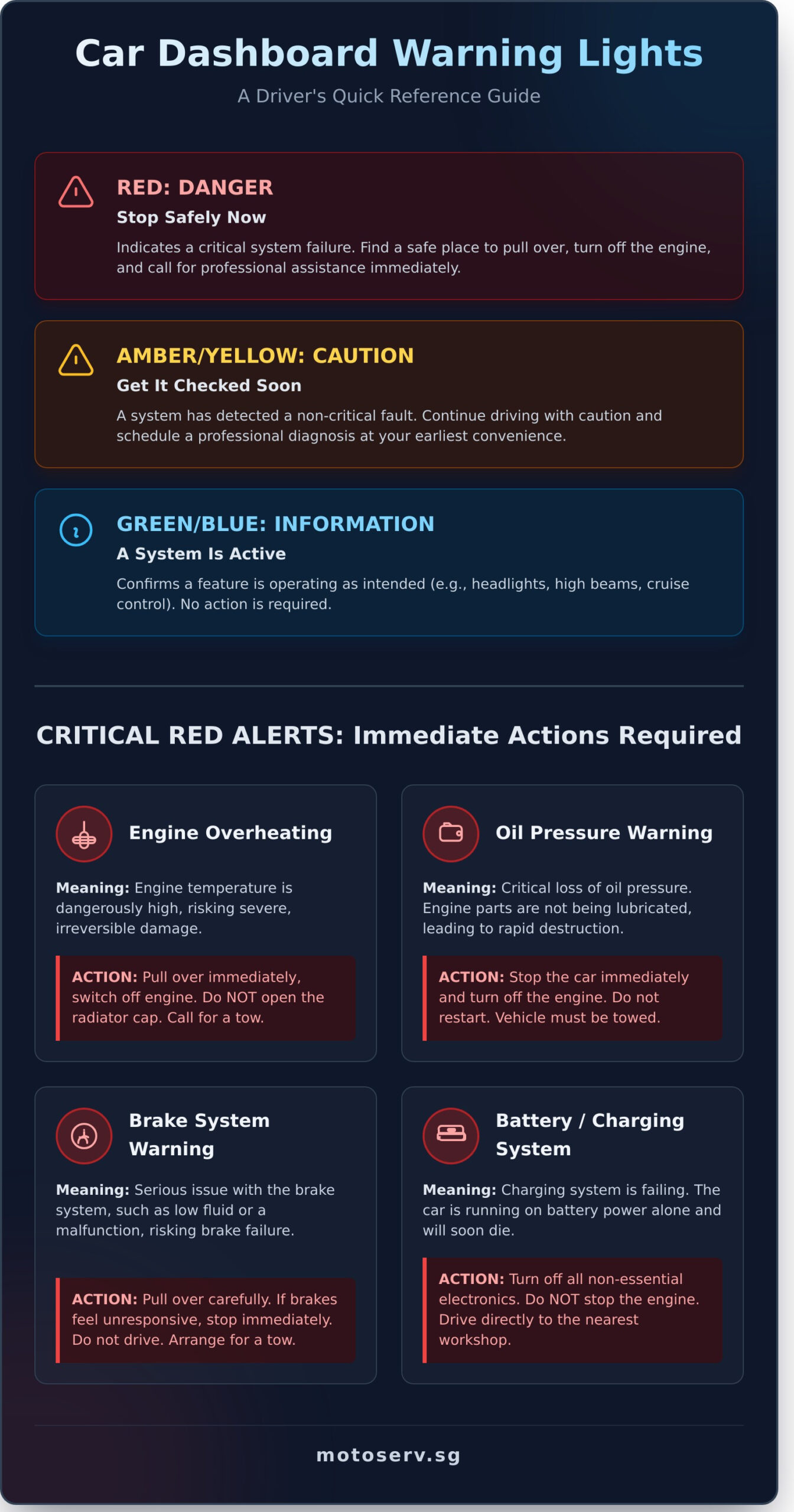
The Dashboard Traffic Light System: Red, Amber, and Green Explained
When a symbol suddenly illuminates on your dashboard, it’s easy to feel a sense of unease. However, understanding the basic car warning lights meaning is the first step to handling the situation calmly and correctly. Fortunately, almost every modern vehicle uses a simple and intuitive “traffic light” system to communicate the urgency of an issue. This colour-coded system is a universal standard designed to help you instantly assess the situation.
Knowing what each colour represents empowers you as a driver, turning panic into proactive decision-making. These official Dashboard warning lights, technically known as tell-tales, are your car’s primary way of communicating its health. By learning this simple language, you can ensure both your safety and your vehicle’s longevity.
Red Lights: Danger – Stop Safely Now
A red warning light signals a serious, often safety-critical, problem that requires your immediate attention. Ignoring a red light can lead to severe engine damage, component failure, or a dangerous situation on the road. It is your car’s way of saying “stop now.”
- Indication: A critical system failure (e.g., brakes, engine oil pressure, coolant temperature).
- Action Required: Find the nearest safe place to pull over, turn off the engine, and call for professional assistance. Do not continue driving.
Amber or Yellow Lights: Caution – Get It Checked Soon
Amber or yellow lights act as a caution sign. They indicate that a system has detected a potential issue or malfunction that is not immediately hazardous but should not be ignored. While you can typically continue your journey, addressing the problem promptly can prevent it from escalating into a more serious and costly repair.
- Indication: A non-critical fault (e.g., check engine, tyre pressure, ABS fault).
- Action Required: Drive with caution and schedule an appointment with a trusted workshop, like Motoserv, at your earliest convenience for a professional diagnosis.
Green or Blue Lights: Information – A System is Active
Unlike red and amber lights, green or blue lights are not warnings. They are purely informational indicators designed to confirm that a particular system is switched on and operating as intended. Seeing one of these lights is perfectly normal and simply serves as a helpful reminder while you drive.
- Indication: A feature is currently in use.
- Examples: Headlights are on (green), high beams are activated (blue), or cruise control is engaged (green).
- Action Required: None, unless you intend to turn the indicated system off.
Critical Red Warning Lights: Meanings & Immediate Actions
Of all the symbols on your dashboard, red warning lights demand your immediate attention. Understanding the basic car warning lights meaning is crucial for every driver in Singapore, as these signals indicate a potentially serious problem that could affect your safety or lead to costly repairs. Ignoring a red light is never an option. The universal rule is to find a safe place to pull over, stop the car, and turn off the engine as soon as possible. Continuing your journey could result in severe engine damage or a critical safety failure. While this guide covers the most common critical alerts, a comprehensive resource from Top Gear can also help you decipher those warning lights you may encounter.
Engine Overheating Light (Thermometer Symbol)
Meaning: This light indicates that your engine’s temperature has risen above its normal operating limit. This is often caused by a lack of coolant or a fault in the cooling system. Risk: Continuing to drive with an overheating engine can cause catastrophic, irreversible damage, such as a warped cylinder head or complete engine seizure. Action: Safely pull over and switch off the engine immediately. Allow it to cool down for at least 30 minutes. Never attempt to open the radiator cap when the engine is hot, as pressurised steam can cause severe burns. It is safest to call for professional roadside assistance.
Oil Pressure Warning Light (Oil Can Symbol)
Meaning: This is one of the most serious warnings. It signifies a critical drop in engine oil pressure, meaning vital engine components are no longer being lubricated properly. Risk: Without proper lubrication, metal-on-metal friction can destroy an engine within minutes. This is not a “low oil level” light; it is a “no oil pressure” emergency. Action: Stop the car immediately in a safe location and turn off the engine. Do not attempt to restart it. While you can check the oil level once the engine has cooled, the issue is often more complex, like a failed oil pump. Your vehicle must be towed to a workshop for expert diagnosis.
Brake System Warning Light (Exclamation Mark in Circle)
Meaning: This light signals a serious issue within your car’s brake system. It could be due to dangerously low brake fluid, a worn-out sensor, or a malfunction in the anti-lock braking system (ABS). Risk: The risk is a potential failure of your brakes, compromising your ability to stop the vehicle safely. Action: Carefully pull over to a safe spot, testing your brakes gently at a low speed. If they feel spongy or unresponsive, stop immediately. Do not continue your drive. For your safety, have your car professionally inspected by having it towed to a reliable workshop.
Battery or Charging System Light (Battery Symbol)
Meaning: This light indicates that the vehicle’s charging system is failing and the car is running solely on battery power. The cause is typically a faulty alternator or a broken serpentine belt. Risk: Your car will run until the battery is completely drained, at which point the engine will stall and you will lose all electrical power. This could leave you stranded in a dangerous location. Action: Turn off all non-essential electronics like the radio and air-conditioning to conserve power. Do not turn the engine off. Drive directly to the nearest workshop for an immediate check.
Amber & Yellow Warning Lights: What Needs Your Attention Soon
Amber or yellow dashboard lights are your car’s way of saying, “Pay attention.” Unlike red lights, they don’t signal an immediate emergency, but they should never be ignored. Continuing to drive is usually safe, but these warnings indicate a potential issue that could worsen over time. Understanding the car warning lights meaning for these alerts and addressing them promptly is key to preventing costly repairs and ensuring your safety on Singapore’s roads. We recommend booking a professional diagnostic check to identify the root cause.
Check Engine Light (Engine Symbol)
This is one of the most common warnings, indicating a sensor has detected a fault in your engine or exhaust system. The cause can range from a simple loose fuel cap to a more serious issue like a failing oxygen sensor. If the light is solid, get it checked soon. If it’s flashing, it indicates a severe engine misfire. You should stop driving immediately to prevent serious damage. Our expert mechanics can diagnose the check engine light accurately.
Tyre Pressure Monitoring System (TPMS) Light
This light means one or more of your tyres is significantly under-inflated. This is a safety risk, as low tyre pressure affects handling, increases fuel consumption, and can lead to a dangerous blowout. Your immediate action should be to drive to the nearest petrol station and inflate your tyres to the manufacturer’s recommended pressure. If the light remains on, you may have a puncture or a faulty sensor that needs professional attention.
Anti-Lock Braking System (ABS) Light
When the ABS light comes on, it means there’s a fault with your Anti-Lock Braking System. Your standard brakes will still work. However, the crucial anti-lock feature, which prevents skidding during emergency braking, is disabled. Drive with extra caution, especially in wet conditions, and allow for longer braking distances. To restore this vital safety feature, have the system inspected by a qualified technician.
Traction/Stability Control Light (Car with Wavy Lines)
This light has two states. If it’s flashing, the system is actively working to maintain traction on a slippery surface—this is normal. If the light stays on and is solid, it signals a fault in the traction or stability control system. While you can still drive, your car will have reduced grip in challenging conditions. Drive more cautiously and book a diagnostic check at a reliable workshop to resolve the issue.
What to Do When a Warning Light Comes On: A 3-Step Plan
Seeing a new light flash on your dashboard can be alarming. However, understanding the basic car warning lights meaning and having a clear plan can make all the difference. This simple 3-step guide is designed for Singapore drivers to help you stay calm, act safely, and prevent a minor alert from turning into a major, costly repair. By knowing exactly what to do, you remain in control of the situation.
Step 1: Identify the Colour and Don’t Panic
Your first action is simple: stay calm and note the colour of the light. The colour is a universal guide to the urgency of the situation.
- Green or Blue: Indicates a system is active, such as your high beams or cruise control. No action is needed.
- Amber or Orange: This is a caution. A non-critical system needs attention soon. You can continue driving but should plan to get it checked.
- Red: This signals a potentially serious problem that requires immediate attention. You should find a safe place to stop as soon as possible.
Remaining calm is the key to making a safe and logical decision on the road.
Step 2: Find a Safe Place to Stop
If you see a red warning light, your priority is to stop driving to prevent further damage or a safety risk. Signal your intention clearly and carefully move to the road shoulder, a nearby lay-by, or the nearest available car park. Avoid braking suddenly or stopping in a location that obstructs traffic. Once you are safely stopped, turn off the engine and switch on your hazard lights to alert other drivers.
Step 3: Get a Professional Diagnostic Check
A warning light tells you that a problem exists, but it rarely pinpoints the exact cause. Guesswork can lead to unnecessary repairs and added costs. The most reliable way to resolve the issue is with a professional diagnostic scan. At Motoserv, our experienced mechanics use advanced diagnostic equipment to accurately read your vehicle’s specific fault codes. This data-driven approach ensures we identify the root cause and fix the right problem the first time, saving you time and money. Entrust your car with us for a reliable and transparent diagnosis.
Don’t Guess, Get It Checked by the Experts
Your car’s dashboard is its most direct line of communication. Understanding the ‘traffic light’ system of red, amber, and green symbols is the first step to staying safe and avoiding expensive damage. But knowing the general car warning lights meaning is only half the battle. When a symbol lights up, it’s a clear signal that your vehicle needs professional attention, and ignoring it can lead to more serious issues down the road.
Instead of worrying, get a definitive answer. At Motoserv, our team of IMI (UK) certified mechanics uses advanced diagnostic tools to provide an accurate and reliable assessment. As a CASETRUST accredited workshop, we are committed to transparency and fairness, giving you the peace of mind you deserve. Don’t ignore a warning light. Book a professional diagnostic check at your nearest Motoserv workshop today. Drive with confidence, knowing your car is in expert hands.
Frequently Asked Questions About Car Warning Lights
Why is my check engine light flashing on and off?
A flashing check engine light signals a serious and urgent problem, typically an engine misfire. This condition can rapidly damage expensive components like your catalytic converter. Unlike a steady light that indicates a less critical issue, a flashing light demands immediate attention. For your safety and to prevent costly repairs, we strongly advise you to pull over safely and turn off your engine as soon as possible. Contact a professional workshop for immediate assistance.
Can I just reset the car warning light myself?
While it is possible to clear a warning light using an OBD-II scanner, we do not recommend it. Resetting the light only erases the error code; it does not fix the underlying mechanical or electrical fault. The light will inevitably return until the root cause is addressed. A proper diagnosis from an experienced mechanic is essential to identify and repair the actual problem, ensuring your vehicle remains safe and reliable on Singapore’s roads.
Is it safe to drive with the ABS or Airbag light on?
Driving with these lights on poses a significant safety risk. When the ABS light is on, your anti-lock braking system is inactive, which can compromise your control during an emergency stop. Similarly, an illuminated airbag (SRS) light means the airbag system has a fault and may not deploy in a collision. While the car may seem to drive normally, these crucial safety systems are compromised. We advise getting them inspected by a certified professional immediately.
My car seems to be driving fine, can I ignore the warning light?
Ignoring a warning light, even if your car feels normal, is never a good idea. Many dashboard lights signal underlying issues that do not have immediate symptoms, such as a failing sensor that could be affecting your fuel efficiency or emissions. Addressing these alerts promptly can prevent minor faults from escalating into major, more expensive repairs down the line. It is always the safest and most cost-effective approach to have the issue professionally diagnosed.
In some unfortunate cases, a professional diagnosis reveals that the repair costs exceed the vehicle’s value, effectively making it a junk car. When this happens, selling it for cash becomes a practical next step. For drivers in the US, for example, services like Cash For Junk Cars Michigan offer a way to handle vehicles that are no longer feasible to repair, providing a clear alternative to costly fixes.
What’s the difference between the Oil Pressure and Oil Level light?
Understanding the car warning lights meaning is crucial here. The oil level light (often yellow/amber) simply indicates that your engine oil is low and needs to be topped up. However, the oil pressure light (usually red) is a critical warning. It means oil is not circulating properly to lubricate your engine. If you see this light, you must stop driving immediately and turn off the engine to prevent severe, irreversible damage.
Do all cars have the same warning light symbols?
Many core symbols, such as the check engine, battery, and oil pressure lights, are standardised across most vehicle manufacturers. However, symbols for advanced features like driver-assist systems, hybrid powertrains, or specific electronic functions can vary significantly between brands and models. Your vehicle’s owner’s manual is always the most accurate reference. If you are ever unsure, it is best to seek professional advice from an expert technician.