
That sudden, unfamiliar sound from your engine—a high-pitched squeal, a deep clunk, or a persistent grind—is more than just an annoyance. It’s a warning sign that can instantly trigger worries about safety, unexpected breakdowns on the PIE, and the potential for a high repair bill. When your car is making noises it shouldn’t, it’s trying to tell you something important about its health. But the anxiety of not knowing what the sound means, or how to accurately describe it to a mechanic, can be just as stressful as the noise itself.
This guide is designed to provide clarity and peace of mind. We will help you decipher 10 of the most common sounds your car can make, from squealing brakes to a rattling exhaust. You will gain a clear understanding of the potential cause and severity of each noise, know whether it is safe to continue driving, and learn the right next steps to take for a reliable repair. Consider this your first step towards confidently handling your car’s health and ensuring your safety on Singapore’s roads.
Decoding High-Pitched Noises: Squeals, Screeches, and Hisses
High-pitched sounds like squeals, screeches, and hisses are your car’s way of demanding attention. These sharp noises often indicate friction between components or a leak in a critical system. They are usually the first signs of wear and tear, and ignoring them can lead to more complex and costly repairs. When your car is making noises like these, a professional diagnosis is always recommended. Understanding the basics of what a mechanic does to trace these sounds can help you assess the urgency and protect your vehicle.
A High-Pitched Squeal When Starting or Accelerating
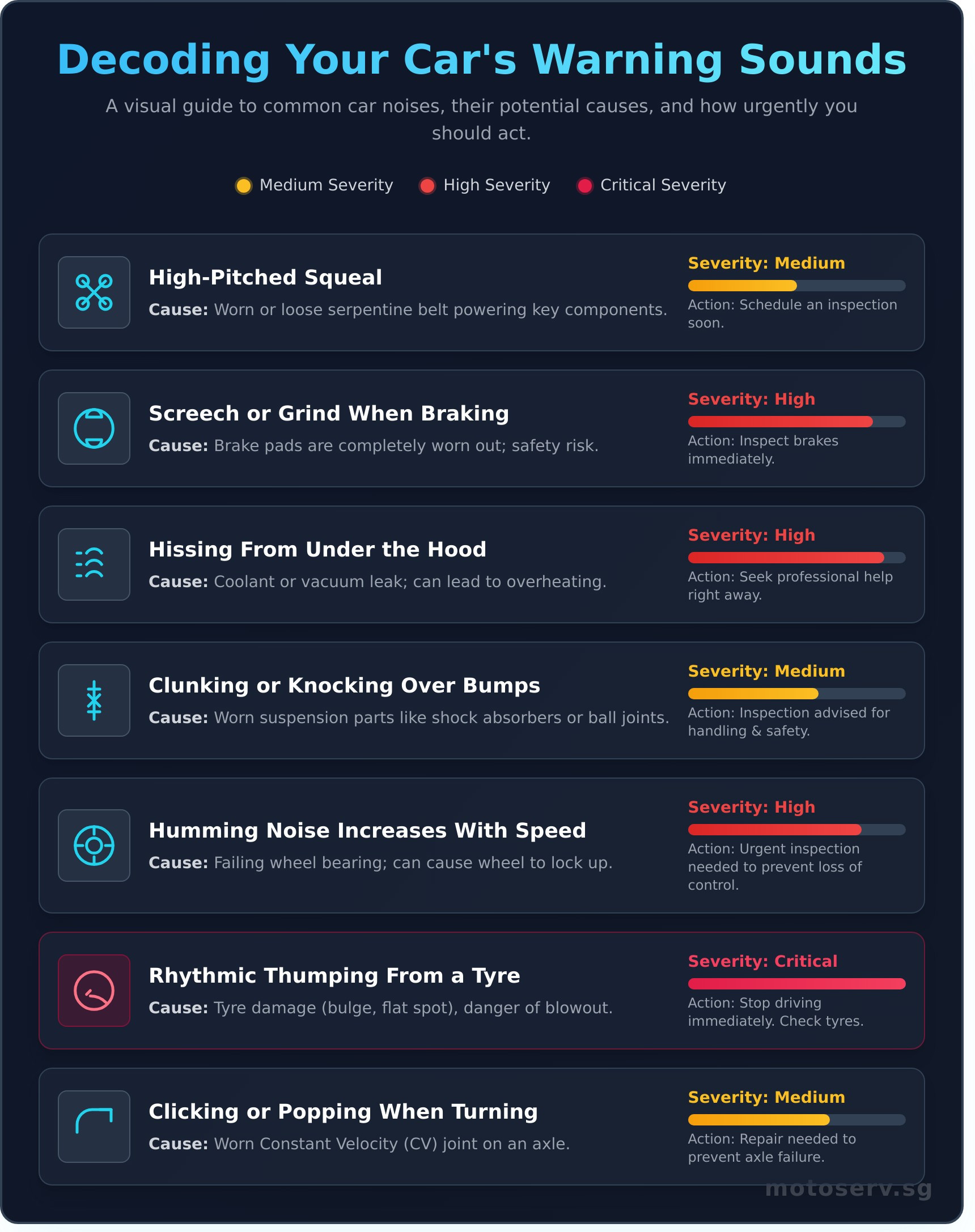
If you hear a shrill squeal when you start your car or press the accelerator, the most likely culprit is a worn or loose serpentine belt. This crucial component powers essential systems like the alternator, water pump, and air-conditioning compressor. Ignoring this sound can lead to a dead battery or, more seriously, engine overheating. This is a clear warning sign that a key part is failing.
Severity: Medium. While your car is likely still driveable, you should schedule an inspection with a professional mechanic soon to avoid a sudden breakdown and ensure your safety.
A Sharp Screech or Grind When Braking
A high-pitched screech or metallic grinding sound when you apply the brakes is an urgent safety warning. This noise is typically caused by the built-in wear indicator on your brake pads—a small metal tab designed to contact the brake disc when the pads are worn out. Continuing to drive will not only compromise your stopping power but can also severely damage the more expensive brake discs, leading to a much costlier repair.
Severity: High. This is a critical safety issue. We advise you to have your brakes inspected by a certified professional immediately.
A Hissing Sound From Under the Hood
A hissing noise from the engine bay, especially if it continues after turning the engine off, often points to a leak. This could be a vacuum leak, which affects engine performance, or a coolant leak from a hose or the radiator. A coolant leak is particularly dangerous as it can quickly lead to the engine overheating, which may cause severe and permanent damage that is expensive to fix.
Severity: High. An overheating engine can result in catastrophic failure. Do not drive the vehicle if you suspect a coolant leak and seek professional assistance right away.
Investigating Deeper Sounds: Clunks, Thumps, and Grinds
While high-pitched sounds are alarming, deeper, low-frequency noises like clunks, thumps, and grinds often signal developing problems with your car’s foundational components. These are the sounds you might feel through the floor or as a vibration in the steering wheel. Paying close attention to when your car making noises—whether it’s over bumps, during turns, or at certain speeds—is crucial for an accurate diagnosis. These sounds can indicate a serious mechanical failure is imminent, making a professional inspection essential for your safety on Singapore’s roads.
4. A ‘Clunking’ or ‘Knocking’ When Driving Over Bumps
This distinct sound often points to worn-out suspension components like shock absorbers, struts, or ball joints. These parts are vital for a stable, smooth ride and precise handling. When they wear down, the metal-on-metal contact creates a clunking noise. Ignoring this can lead to poor vehicle control and accelerated, uneven tyre wear. While not immediately critical, it compromises your safety and comfort, so an inspection by an expert mechanic is highly recommended.
- Common Cause: Worn shock absorbers, struts, or ball joints.
- Severity: Medium. Affects safety and vehicle handling; inspection is advised.
5. A Deep, Rumbling or Humming Noise That Gets Louder with Speed
A persistent humming or rumbling that intensifies as you accelerate is a classic symptom of a failing wheel bearing or a differential issue. The wheel bearing is a crucial part that allows your wheel to spin with minimal friction. You might notice the sound changes pitch or disappears when you turn left or right, which helps pinpoint the affected wheel. Understanding these common car noises and what they mean is key to early detection. This issue is severe; a completely failed bearing can cause the wheel to lock up while driving, leading to a total loss of control.
- Common Cause: Failing wheel bearing or differential problem.
- Severity: High. A failed bearing can cause the wheel to seize, creating a dangerous situation.
6. A Rhythmic Thumping Sound from a Tyre
If you hear a ‘thump-thump-thump’ that matches the rhythm of your wheel rotation and gets faster as you speed up, the cause is almost always a tyre issue. This is a critical safety warning. The sound could be from a flat spot, low tyre pressure, or, most dangerously, a bulge in the sidewall. A bulge indicates that the tyre’s internal structure has failed and a blowout is imminent. When your car is making noises like this, pull over safely as soon as possible and inspect your tyres. Do not continue driving.
- Common Cause: Tyre damage (bulge, flat spot) or dangerously low pressure.
- Severity: Critical. Stop driving immediately and inspect your tyres to prevent a blowout.
Identifying Rhythmic Noises: Clicking, Ticking, and Whirring
Unlike the sudden clunks or persistent drones, rhythmic sounds are often directly synchronised with the rotation of your car’s components. The frequency of these noises—such as clicking, ticking, or whirring—will usually increase as your engine RPM or vehicle speed rises. This is a key indicator that the issue is related to the engine’s moving parts, your wheels, or the axles connecting them. A light, fast tick might point to a lubrication problem, while a heavier knock can signal more severe internal engine wear.
Paying attention when your car making noises of this nature is crucial, as they are often the earliest warnings of developing issues that can be addressed before they become costly failures.
7. A ‘Clicking’ or ‘Popping’ Noise When Turning Sharply
This is the classic symptom of a worn Constant Velocity (CV) joint. These critical parts connect your car’s transmission to the wheels, allowing them to turn and move with the suspension. The clicking sound is most noticeable during slow, tight turns, such as navigating a multi-storey car park. While you can still drive, a completely failed CV joint will leave your car unable to move, making this a medium-severity issue that needs prompt attention.
8. A Fast Ticking or Tapping From the Engine
A rapid ticking noise that speeds up as you accelerate often points to a problem in the engine’s valvetrain. The most common cause is a low engine oil level or poor oil pressure, which prevents vital components like lifters and camshafts from getting the lubrication they need.
- Immediate Action: Check your engine oil level as soon as the engine has cooled down.
- Severity: High. Driving with insufficient oil can quickly lead to catastrophic engine damage, resulting in one of the most expensive repairs a car can need.
9. A Whining or Whirring From the Transmission
If you hear a whining or whirring sound that changes pitch as you shift gears or accelerate, it likely originates from your automatic transmission. This could be a sign of low transmission fluid, which is the lifeblood of the system, or it could indicate internal wear on gears or bearings. Because transmission repairs are complex and costly, this is a high-severity warning. Early diagnosis by a professional is key to preventing a complete failure.
10. A Rattling Noise From Under the Car
A metallic rattle, especially at idle or low speeds, is frequently caused by a loose part in your exhaust system. The most common culprits are a heat shield that has come loose or the internal components of a failing catalytic converter breaking apart. While not always an immediate emergency, it should not be ignored. A loose part could eventually fall off, and a failing converter can lead to a dangerous exhaust leak or blockages. This is a low to medium-severity issue that is best inspected by an expert.
If your car making noises matches any of these descriptions, it is always safer and more cost-effective to seek a professional diagnosis. Entrust your vehicle with our IMI-certified mechanics for an expert inspection and your peace of mind.
Your Action Plan: What to Do When Your Car Makes a Strange Noise
Hearing an unexpected sound from your vehicle can be stressful. However, reacting with a calm and methodical approach is the most effective way to handle the situation. This simple action plan empowers you to gather the right information, prioritise your safety, and get a professional, accurate diagnosis. When your car is making noises it shouldn’t, a clear head is your best tool.
Step 1: Don’t Panic. Observe and Note the Details
Before you can fix a problem, you need to understand it. Pay close attention to the sound and make a few mental notes (or write them down). This information is incredibly valuable for our mechanics, helping them to diagnose the issue far more quickly and accurately. Ask yourself:
- When does it happen? Only when braking, turning, accelerating, or starting the engine?
- Where is it coming from? Does it seem to be from the front or back of the car, directly from the engine bay, or from underneath you?
- How does it change? Does the noise get faster or louder as you increase speed? Is it constant or does it come and go?
Step 2: Check If It’s Safe to Continue Driving
Your safety on the road is always the top priority. Certain noises are clear indicators of a serious problem that requires you to stop driving immediately. If you hear or see any of the following red flags, pull over to a safe location as soon as possible and call for assistance:
- Loud grinding or scraping from the brakes.
- A rhythmic thumping that matches your tyre rotation.
- Any visible smoke coming from the engine or exhaust.
- A flashing engine management light on your dashboard.
For less severe noises, it may be safe to proceed with caution. Avoid high speeds and harsh acceleration, and make it your priority to book a professional inspection.
Step 3: Schedule a Professional Diagnostic Check
While online forums can offer clues, guesswork can lead to unnecessary and costly repairs. The most reliable way to understand the root cause is to seek an expert opinion. Our experienced, IMI-certified mechanics use specialised diagnostic tools to pinpoint the exact source of the problem, saving you time and money in the long run.
This professional approach ensures we only repair what’s necessary, providing a transparent and honest solution to get you back on the road safely. Heard a worrying noise? Entrust your car to our experts for an accurate diagnosis.
Your Next Step to a Quiet, Reliable Drive
Understanding the squeals, clunks, and clicks your vehicle makes is the first step towards responsible car ownership. As we’ve explored, high-pitched sounds often point to brake or belt issues, while deep grinding can signal more serious problems. The most important takeaway is that your car making noises is its way of communicating a need for attention—a message you should never ignore.
While this guide provides a starting point, an accurate diagnosis is crucial for your safety and to prevent costly damage. For a definitive and professional assessment in Singapore, entrust your vehicle to a team that offers quality you can count on. As a CASETRUST Accredited workshop, we guarantee transparency and reliability. Our experienced mechanics are certified to handle Japanese, Continental, and even EV models with expert precision.
With multiple convenient locations across Singapore, your peace of mind is never far away. Don’t let a strange noise turn into a major repair. Book a professional diagnostic check at your nearest Motoserv workshop today. Drive with confidence, knowing your car is in the best hands.
Frequently Asked Questions About Car Noises
Can I keep driving my car if it’s making a noise?
While some noises may seem minor, it is never advisable to ignore them. A sound is your car’s way of signalling a potential issue. Continuing to drive when your car is making noises could lead to more severe damage and costlier repairs, or even compromise your safety on the road. For peace of mind, we strongly recommend having the vehicle inspected by a certified professional as soon as possible to diagnose the root cause accurately and ensure your safety.
How can I best describe a strange car noise to my mechanic?
To help our mechanics diagnose the issue efficiently, try to note the specifics. When does the noise occur—when turning, braking, or accelerating? Where does it seem to come from—the engine, wheels, or under the car? What does it sound like—a squeal, a clunk, a hiss, or a grind? Providing these details allows our expert team to pinpoint the problem more quickly, ensuring a reliable and transparent repair process for you.
Why does my car only make noise when it’s cold or when the aircon is on?
Noises that appear only when the engine is cold often relate to parts that need proper lubrication, as engine oil is thicker at lower temperatures. A squealing sound could be a worn belt that has contracted. Similarly, a noise that starts with the aircon is typically linked to the A/C compressor or its clutch engaging. Our experienced mechanics can easily distinguish between these issues to provide an accurate diagnosis and an effective solution.
Are strange car noises covered by my vehicle’s warranty?
This depends on the cause of the noise and the terms of your specific warranty. Manufacturer warranties typically cover defects, so if a noise is from a faulty component, it may be covered. However, noises from normal wear-and-tear items like brake pads or certain belts are usually not included. We recommend checking your warranty booklet. Our team can provide a detailed diagnostic report to assist with any potential claims.
How much does it typically cost to diagnose a car noise in Singapore?
The cost for a professional diagnostic check in Singapore typically ranges from S$80 to S$150. This fee covers our mechanic’s expert time and the use of specialised equipment to accurately identify the source of the problem. At Motoserv, we believe in transparent pricing. We will provide you with a clear quote for the diagnostic service and will only proceed with any repairs after receiving your full approval, ensuring there are no surprises.
Could the hot and humid Singapore weather cause certain car noises?
Absolutely. Singapore’s high heat and humidity can accelerate the wear of rubber components like drive belts and suspension bushings, leading to squeaking or groaning sounds. The constant demand on your air conditioning system can also cause noises from a stressed compressor or fan. This climate puts extra strain on your vehicle’s systems, making regular checks by our professional team essential for preventing unexpected issues and ensuring reliability on the road.