Last updated: 18 November 2026
Shock absorber replacement in Singapore is one of those jobs most drivers put off, because worn shocks fade slowly and you get used to the ride. But your shocks do more than keep things comfortable. They keep your tyres pressed onto the road, which affects braking, cornering and grip on wet expressways during the monsoon season. This guide explains the warning signs, a simple check you can do at home, and what happens when you bring your car to Motoserv.
Quick answer: Replace your shock absorbers when the car keeps bouncing after humps, dips hard under braking, sways in corners, leaks oil from the shock body, or wears tyres unevenly. There is no single mileage for every car, so have them inspected at each service and follow your owner’s manual. Shocks are usually replaced in pairs, front or rear.
What do shock absorbers actually do?
Shock absorbers (often called dampers or, on many cars, part of a strut) control how fast your springs compress and rebound. The spring carries the weight of the car. The shock stops it from bouncing up and down like a pogo stick after every bump.
When a shock wears out, the spring is left uncontrolled. The tyre can lose firm contact with the road for a moment after a hump or pothole. On a dry day you may only feel a floaty ride. On a wet road, that lost contact means longer braking distances and less grip when you swerve.
What are the signs you need shock absorber replacement?
Look out for these 7 signs. One alone is worth a check; two or more usually means the shocks are tired.
- Bouncing after humps. The car keeps bobbing after a road hump or carpark ramp instead of settling quickly.
- Nose-diving when braking. The front dips sharply under firm braking and the rear lifts.
- Body roll and sway. The car leans more than it used to in corners, or feels unsettled in crosswinds and on expressway curves.
- Oil on the shock body. A wet, oily film on the outside of the shock usually means the internal seal has failed.
- Uneven tyre wear. Patchy or cupped wear (scalloped dips across the tread) can come from a tyre that hops instead of rolling smoothly.
- Knocking or clunking over bumps. Worn shock mounts, bushings or a failed shock can knock on uneven roads.
- A harsh or floaty ride. Either the car feels crashy over every bump, or it wallows and floats at speed.
How long do shock absorbers last?
It depends on the car, the load you carry and the roads you drive on. Many shocks give good service for years, but they wear gradually, so the change is easy to miss. In Singapore, frequent road humps, multi-storey carpark ramps, stop-start traffic and heavy loads (family trips, Malaysia runs with a full boot) all add wear.
Rather than waiting for a mileage figure, ask for a suspension check during your regular car servicing. If your car is more than a few years old or you are planning to renew your COE, it is a good time to have the whole suspension looked at.
Can you check your shock absorbers at home?
Yes, a few simple checks help you decide whether to book an inspection:
| Check | How to do it | What a problem looks like |
|---|---|---|
| Bounce test | Push down firmly on one corner of the car and release. | The car bounces more than once or twice before settling. |
| Visual check | With a torch, look behind each wheel at the shock body. | Oily residue or dripping fluid on the shock. |
| Tyre check | Run your hand across the tread of each tyre. | Cupped or patchy wear, or one tyre wearing faster than the others. |
| Ride check | Drive over a familiar road hump at low speed. | Extra bouncing, knocking or a floaty feeling. |
| Brake check | Brake firmly in a safe, empty space. | Heavy nose-dive or the car pulling to one side. |
These checks are a guide only. A technician can lift the car and inspect the shocks, mounts, springs and bushings properly.
Is it safe to drive with worn shock absorbers?
You can usually drive the car, but it is less safe than it should be. Worn shocks can increase braking distance, make the car harder to control in an emergency swerve, and increase the risk of aquaplaning on wet roads. They also speed up wear on tyres and other suspension parts, so a cheap fix today can become a bigger bill later.
If a shock is leaking heavily, a spring has broken, or you hear loud knocking, get it checked as soon as possible.
Should you replace shock absorbers in pairs?
Yes. Shocks are normally replaced in pairs on the same axle (both fronts or both rears), so the car stays balanced from left to right. Replacing only one can make the car feel uneven when braking or cornering. Your technician will also check the mounts, dust covers and bump stops, since worn ones can shorten the life of new shocks.
After suspension or steering work, a wheel alignment is recommended because new parts can change the alignment. Wheel alignment is not done at Motoserv workshops, so our team will advise you on where to go.
When should you see a workshop?
- The car bounces, floats or nose-dives noticeably.
- You see oil on a shock absorber.
- Your tyres are wearing unevenly or faster than expected.
- You hear knocking or clunking over bumps.
- You are buying a used car or planning to renew your COE.
- Your car is due for its LTA inspection and the ride feels off.
How Motoserv helps with shock absorber replacement
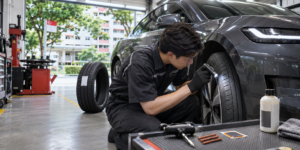
Our technicians inspect your suspension, show you what is worn and give you a quote before any work starts. Our suspension and steering repair service covers shock absorbers and springs, bushings, ball joints, stabiliser links, tie rods, steering racks and CV joints.
You can also ask for a suspension check during any servicing package, or as part of our pre-COE renewal inspection or LTA inspection pre-check. Buying a used car? Our pre-purchase inspection helps you spot worn suspension before you commit.
Motoserv has 12 outlets across Singapore: Toa Payoh, Serangoon Garden, Bukit Batok, Bukit Panjang, Upper Bukit Timah, Upper Thomson, Havelock Road, River Valley, Jurong, Sembawang, Bukit Merah and Yishun. Find the nearest one on our contact page.
Related reading: reasons your car is bumpy when driving, CV joint replacement and more tips in our car care articles.
Key takeaways
- Shock absorbers keep your tyres on the road, so worn shocks affect braking and grip, not just comfort.
- Bouncing, nose-diving, body roll, oil leaks and uneven tyre wear are the main warning signs.
- There is no fixed replacement mileage; have them checked at every service.
- Replace shocks in pairs on the same axle, and get a wheel alignment afterwards.
- Motoserv inspects first and quotes before starting work.
FAQs
How do I know if my shock absorbers are worn?
Common signs are a bouncy or floaty ride, the front dipping hard under braking, extra body roll in corners, oil on the shock body and uneven tyre wear. A technician can confirm this by inspecting the car on a lift.
How often should shock absorbers be replaced?
There is no single interval for all cars. Wear depends on the model, load and road conditions. Follow your owner’s manual and ask for a suspension check at each service, especially on older cars.
Can I replace just one shock absorber?
It is best to replace shock absorbers in pairs on the same axle. A new shock on one side and a worn one on the other can make the car feel unbalanced when braking and cornering.
Do I need a wheel alignment after replacing shock absorbers?
Yes, an alignment is recommended after suspension or steering work, because new parts can change the wheel angles. Wheel alignment is not done at Motoserv workshops, and our team will advise you where to go.
How much does shock absorber replacement cost in Singapore?
The cost depends on your car model and the parts needed. At Motoserv we inspect the car, show you what is worn and give you a quote before starting any work.
Book a suspension check at Motoserv
If your car is bouncing, swaying or wearing tyres unevenly, do not wait for the next bump to remind you. Book a service at motoserv.sg and choose the Motoserv outlet nearest you.